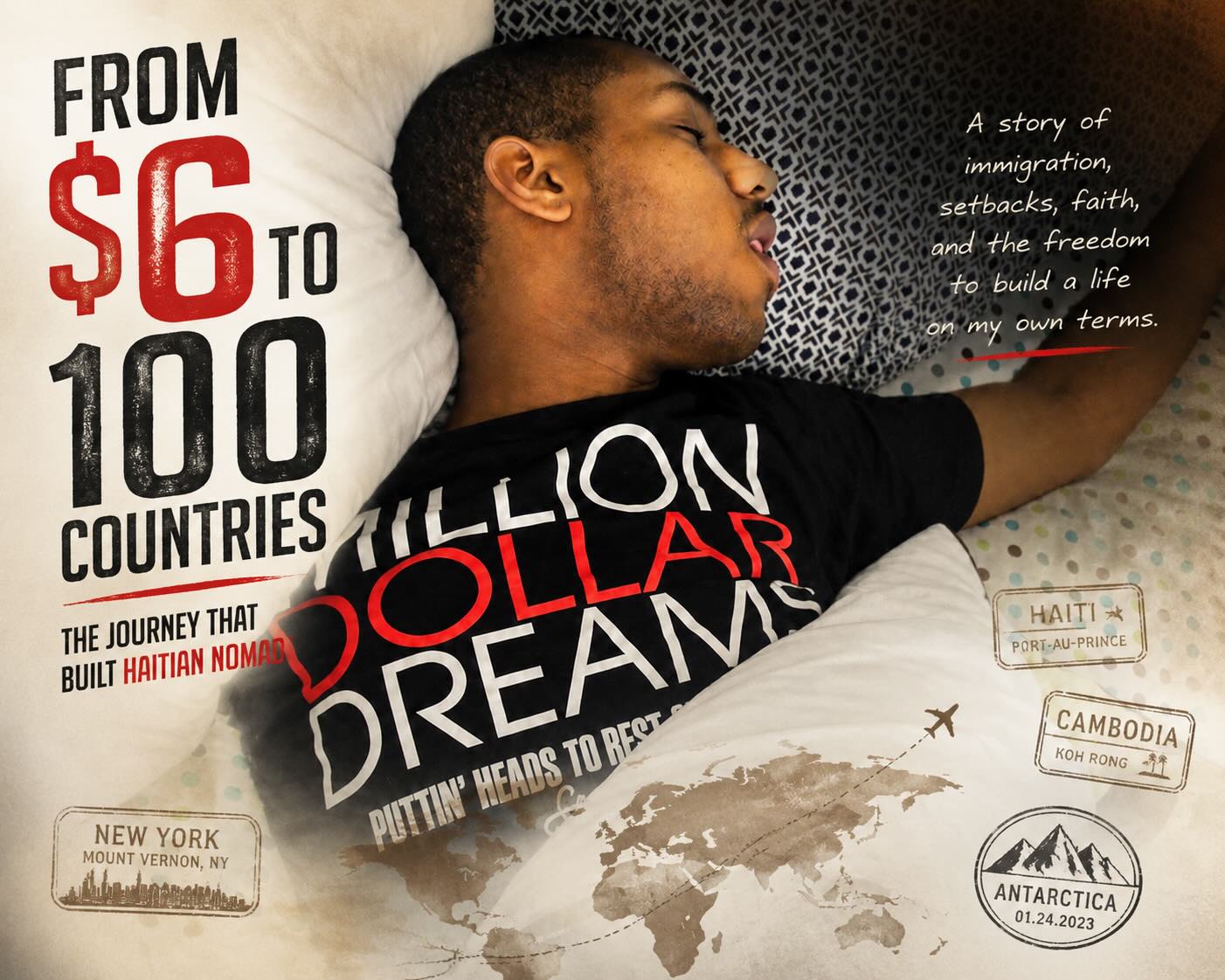
I was born and raised in Port-au-Prince, Haiti, in a middle-class family. Growing up, I never imagined that travel would one day become my life, much less my livelihood.
In fact, for most of my childhood, there was only one place outside of Haiti that I knew: New York.
I first traveled there when I was just one month old, and throughout my childhood, New York became where I spent summers and Christmas breaks with my cousins. Haiti was home. New York was where we visited.
I had no idea then how much those two places would eventually shape my life.
The Letter That Changed Our Family
Long before my own immigration story began, there was my grandmother's.
My maternal grandmother was a teacher who had been educated in France. After being harassed by a group of men in Haiti, she made a decision that would ultimately change the trajectory of our entire family: she left.
She vowed never to return.
But leaving meant leaving behind six children.
She went to New York, where she lived as an undocumented immigrant and worked multiple jobs to support the children she had left in Haiti. At some point, with seemingly nowhere else to turn, my grandmother did something audacious.
She wrote a letter to the President of the United States.
Jimmy Carter.
And somehow, someone at the White House read it.
President Carter's office responded through presidential correspondence. He couldn't simply give her a green card, of course, but she was referred to someone who could help her navigate a path toward legal residency.
The rest, as they say, is history.
Once she became a legal resident, my grandmother petitioned for her children, including my mother. My mother's application eventually included my brother, my father and me.
In the fall of 1996, we received our green cards.
But we didn't immediately move to America.
My father worked at the U.S. Embassy in Haiti, and we were fortunate enough to remain in Port-au-Prince. So life continued much as it always had.
Until the summer of 2003.
The Summer Vacation That Never Ended
I came to New York that summer the same way I had so many times before: expecting to go home.
But while I was there, Haiti's political situation continued to deteriorate.
At the time, I was dating a girl who happened to be my neighbor back in Haiti. Our families were close, and her mother loved me. She convinced my parents to allow me to remain in the United States with their family rather than return home.
And just like that, my life changed.
I was enrolled at Mount Vernon High School in Westchester County, New York.
They placed me directly into the 12th grade.
Imagine entering an entirely different education system and being told almost immediately:
Okay. Now graduate.
I had to learn how the American high school system worked while simultaneously preparing for New York State Regents exams in subjects I had never taken.
And then there was gym.
Apparently, I was missing three years' worth of physical education credits.
So I had gym every day.
And night school for gym.
If you knew me back then and wondered why I seemed to always be wearing sweatpants, now you know.
It was overwhelming, but I had arrived with something far more important than an understanding of the American school system: determination.
I knew how fortunate I was.
I had everything I needed and wanted growing up in Haiti, but I also understood that I had been given an opportunity that countless people around the world would risk everything for.
Failure didn't feel like an option.
Then came January 26, 2004.
I was supposed to take the U.S. History Regents exam that day. I had never actually taken a U.S. History class, but I needed to pass the exam to graduate.
And then one of the biggest snowstorms of the winter hit New York.
The exam requirements were waived.
Sometimes in life, a door opens.
Sometimes a snowstorm opens it for you.
I graduated.
Getting Into College Was Only Half the Battle
I applied to college and navigated the entire process largely on my own.
Eventually, I was accepted, but even after loans and financial aid, I didn't have enough money to cover tuition.
So I decided to join the military.
I began the process and went with a recruiter to take one of the required tests.
Then the recruiter lost my passport.
And my green card.
Meanwhile, the university kept asking me to produce my green card, and tuition was due.
It felt like another door was closing.
Then, about a week after classes had already begun, my tuition somehow cleared.
One problem solved.
Now I needed somewhere to live.
Residential Life told me what I already expected to hear: school had started. Campus housing was full. Getting a room at that point would essentially be impossible.
Still, I went to the office.
When I told the woman at the desk my name, she stopped.
She asked me if I knew someone named J. Cantave.
My sister.
The woman became emotional.
Apparently, years earlier, my sister had been "born in her hands."
Needless to say, I left that office with a room on campus.
There were too many moments like this to ignore.
Too many people.
Too many doors opening exactly when I needed them.
Whatever I chose to call it—faith, destiny, divine timing—I knew I couldn't waste it.
In 2008, I graduated with a bachelor's degree in Criminology.
And then I entered the workforce at perhaps the worst possible time.
Six Dollars
Anyone who remembers 2008 remembers what happened to the American economy.
I eventually took a job at a hotel and stayed there for four years before being fired after helping someone I considered a friend.
I remember driving home that day and making myself a promise:
From that point forward, I would only pursue work I genuinely wanted to do.
That promise sounds inspiring now.
Living through it wasn't.
There were days when I had six dollars to my name.
Six.
I remember having to make calculations that people don't normally associate with the person they might see traveling around the world today.
Do I buy a Chinese food meal and eat today?
Or do I buy a loaf of bread and peanut butter and make it last for the week?
Those moments stay with you.
Then one day, while browsing Craigslist, I found a job posting that sounded almost ridiculous.
Travel the world.
Possibly go to Africa and Asia.
Help people.
And get paid.
I assumed it might be a scam.
I applied anyway.
It wasn't.
The organization recruited university students throughout the United States and Canada to volunteer abroad. I began traveling around the U.S. and Eastern Canada as a recruiter for Reach Out Volunteers.
Eventually, I was selected to become a team leader in Cambodia.
It would be my first time in Southeast Asia and the farthest from home I had ever traveled.
I fell in love with Cambodia.
For a period of time, I lived and worked on Koh Rong, a remote island that looked like the definition of paradise. I taught children English. We helped build homes in the village. I participated in a scuba-diving conservation program designed to restore the reef ecosystem that local families depended on for food.
On paper, I had found the dream.
I was literally being paid to live on a tropical island and travel the world.
And yet, something was missing.
That experience taught me one of the most important lessons of my life:
Most people don't actually dream of having a job that allows them to travel the world. They dream of having the freedom to travel the world.
There is a difference.
I left.
The People on the Other Side of the Door
Back in New York, I took a job at a church in Manhattan, working in the office and helping with its soup kitchen.
I still remember the excitement of seeing my first paycheck.
$1,000.
At that stage of my life, it felt enormous.
Part of my job involved opening the doors for people coming to the soup kitchen.
One day, I opened those doors and recognized someone.
A friend from college.
He was coming in for help.
That moment has never left me.
We had sat in the same classrooms. Studied the same subject. Walked the same campus.
Now I was on one side of the door and he was on the other.
It reinforced something I had already begun to understand: the distance between stability and crisis can be much smaller than we think.
Years earlier, in one of our criminology classes, we had watched the documentary Dark Days, about people living underground in New York City's railway tunnels. One woman explained how she had ended up homeless after a house fire killed her family and destroyed everything she had.
One event.
One moment.
One completely unexpected turn.
It could be them today.
It could be you tomorrow.
I stopped taking stability for granted.
Getting My Foot in the Door
The movie The Pursuit of Happyness came out in 2006, and although I didn't have a child like the main character, parts of that story resonated deeply with me.
I was trying to figure life out largely on my own while my immediate family remained in Haiti.
Eventually, I came across an administrative assistant position with a human rights organization in Manhattan. Their work immediately spoke to me. They assisted immigrants and worked to hold the U.S. government accountable on human rights issues.
I applied.
I interviewed.
Then they told me the catch.
It wasn't a job.
It was a volunteer position.
I took it anyway.
I believed that if I could get my foot through the door, I could prove my value and eventually turn the opportunity into something more.
So every day, I commuted from Westchester County into Midtown Manhattan to work for free.
Eventually, they hired me.
And I loved that work.
I had opportunities to participate in projects I never could have imagined, including working directly with a human rights defender fighting human trafficking in Congo, where children were being sold by their parents for as little as $50 a year to work in mines.
I was proud of what I did.
At the time, I thought I might have finally found my career.
Then Haiti came calling again.
"Why Don't We Do It in Haiti?"
In 2016, a friend called me with an idea.
She wanted to organize a small gathering centered around Haitian fritay—the fried street foods many of us grew up eating. She was debating whether the gathering should happen in New York or Miami.
I gave her another suggestion.
"Why don't we do it in Haiti?"
There was one problem.
She didn't know anyone in Haiti.
She didn't know where everyone would stay.
She didn't know where we would host it.
Easy, I thought.
We'll use my house.
She said she would mention the idea to the group and get back to me.
That same day, nearly 40 people booked flights to Haiti.
And they were coming to my house.
I immediately called my mother, who was still living in Haiti at the time, and she helped me start putting everything together.
There was no Haitian Nomad business plan.
No investor deck.
No tourism strategy.
I wasn't trying to make money.
I simply saw an opportunity to show people the Haiti I knew—the beauty, culture, food, history and possibility that rarely made international headlines.
We divided the expenses among everyone and made it happen.
Some people slept on the floor of my house.
Others stayed in hotels.
My friends and I drove people around. At times, people were squeezed into the trunk area of my father's SUV.
It was chaotic.
It was imperfect.
It was incredible.
And then came the boat.
The $1,000 Decision That Changed My Life
One of the experiences I was most excited about was a boat outing from a well-known resort.
This was supposed to be one of the highlights of the trip.
We arrived, had a delicious lunch and were ready for an incredible day.
Then the manager pulled me aside.
There had been a discrepancy in the invoice.
The boat wasn't $800.
It was $1,800.
We were short $1,000.
I had a decision to make.
I could go back to a group of people—most of whom I had only just met—and tell them everyone suddenly owed more money.
But I knew exactly how that might look.
They didn't know me.
They didn't know whether there really had been an invoicing mistake.
They could easily think I was scamming them.
So I made a decision without telling anyone.
I paid the $1,000 difference myself.
At the time, I didn't think of it as an investment.
Looking back, it was the first $1,000 I ever invested in Haitian Nomad.
That trip would become legendary within our community.
We called it #FritayGate.
Becoming "The Haiti Guy"
The trip was such a success that afterward, inside a Facebook travel community of nearly 20,000 people, I became known as "the Haiti guy."
People kept asking one question:
"When is the next trip?"
I listened.
I organized another experience in Cap-Haïtien around New Year's.
Then another opportunity came.
And another.
I was still working full-time in human rights, but something was clearly happening.
In June 2017, I officially launched Haitian Nomad.
Around the same time, I won a free trip to Egypt—a country that would eventually become one of Haitian Nomad's signature destinations.
By the end of that year, we were ringing in 2018 in Cambodia.
Then came another January date I will never forget.
January 24, 2018
I had just landed in Haiti with a group when I received the news.
My entire department at work was being laid off.
The job I had once volunteered to do for free—the organization I loved, the work I was proud to tell people about—was gone.
But look at where I was when I received the news.
I was in Haiti.
With a group.
The Port-au-Prince International Jazz Festival had contacted me because they wanted to work with Haitian Nomad to attract younger travelers to Haiti for the festival.
One of Haiti's most famous musicians had personally reached out to me.
I remember being shocked that these people even knew who I was.
These were people I had grown up watching on television.
And now they were calling me.
So when my 9-to-5 disappeared, I made Haitian Nomad my 9-to-5.
Every morning, I got up and worked as though I had somewhere to clock in.
I poured everything I had into this company.
There was no backup plan.
It had to work.
By the end of that same year, Haitian Nomad celebrated New Year's Eve in Egypt with nearly 100 travelers.
Five years later, almost to the exact day, I found myself somewhere I never could have imagined when I first arrived in New York as a teenager.
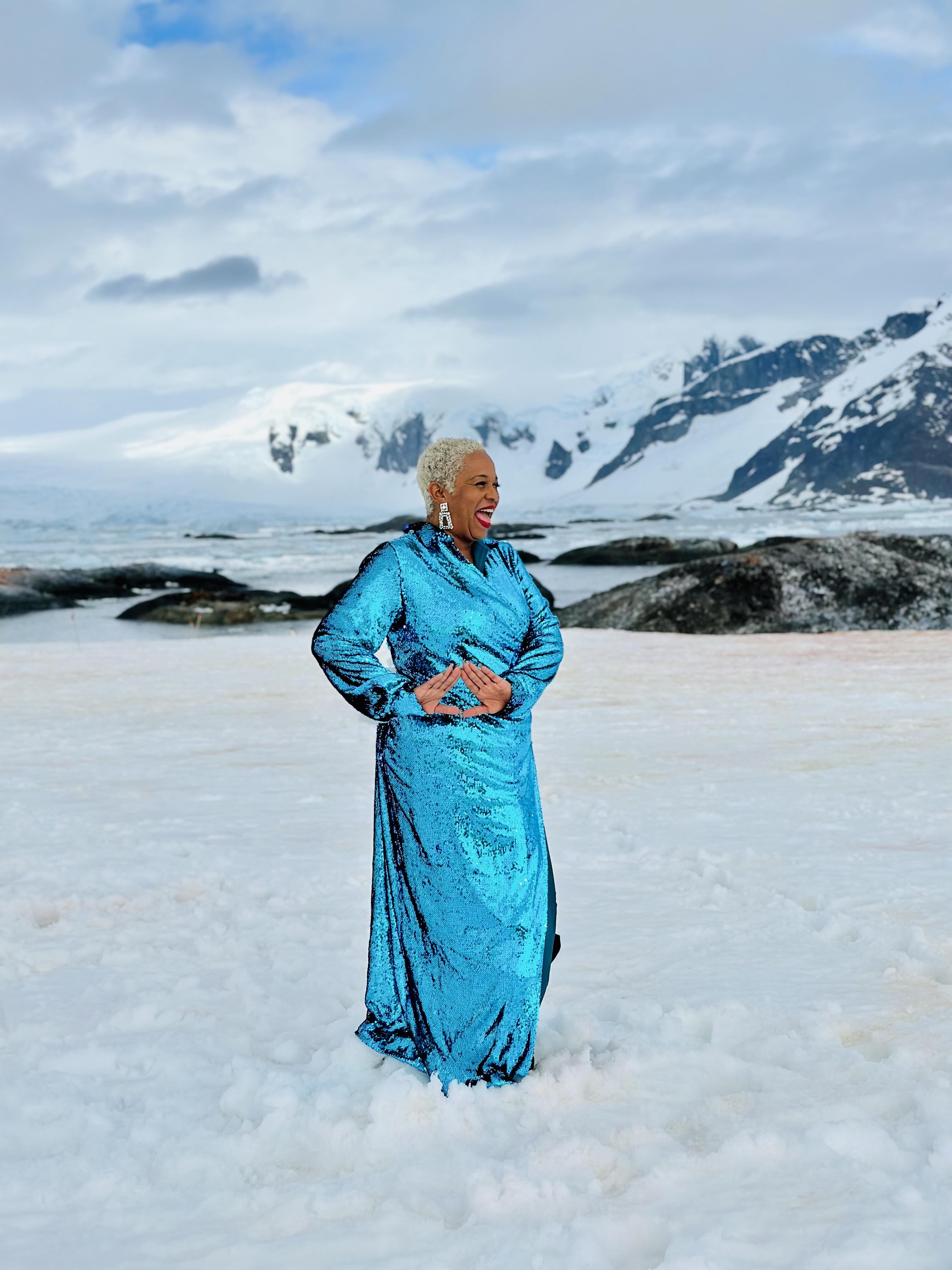
January 24, 2023
I jumped into the ice-cold waters of Antarctica.
Five years earlier, on January 24, I had been told that my job was disappearing.
Now, on January 24, I was standing in one of the most remote places on Earth.
I was living on my own terms.
Writing my own check.
Building something I believed in.
And doing it through travel.
The irony wasn't lost on me.
I once thought my dream was to find a job that would allow me to see the world.
What I actually wanted was freedom.
And somehow, through every setback, every strange coincidence, every person who opened a door for me and every door I had to force open myself, I had found it.
The Journey Continues
When I look back now, it's tempting to connect the dots and make everything seem inevitable.
It wasn't.
There was nothing inevitable about the immigrant teenager trying to understand Regents exams.
Nothing inevitable about tuition mysteriously clearing.
Nothing inevitable about walking into Residential Life and meeting a woman whose connection to my family would help me get a room.
Nothing inevitable about having six dollars and choosing between one hot meal or enough bread and peanut butter to stretch through the week.
Nothing inevitable about answering a Craigslist ad that would send me to Cambodia.
Nothing inevitable about volunteering for a job because I believed I could turn an opportunity into a career.
And certainly nothing inevitable about inviting nearly 40 strangers to my family's home in Haiti.
At almost every stage, I simply made the best decision I could with whatever was in front of me.
Then I kept moving.
Today, I have traveled to more than 100 countries.
Through Haitian Nomad, I've had the privilege of taking thousands of travelers to Haiti, throughout Africa and to extraordinary places across the globe.
And I've been able to make a living doing something I love, with integrity, while never forgetting where I came from.
As Haitian Nomad approaches its tenth anniversary, I've been thinking more about that journey.
About my grandmother, working multiple jobs as an undocumented immigrant in New York and writing a letter to President Jimmy Carter because she refused to give up.
About my parents allowing their teenage son to remain in America because they believed there might be an opportunity waiting for him there.
About the people who opened doors for me.
The people who believed in me.
The people who traveled with me before there was a polished website, a recognized brand or any evidence that this crazy idea would become what it has.
And about God placing people and opportunities along my path at precisely the moments when I needed them.
There is a straight line connecting all of it.
From Port-au-Prince.
To Mount Vernon.
To Manhattan.
To Cambodia.
Back to Haiti.
To Egypt.
And eventually, all the way to Antarctica.
My grandmother left Haiti searching for opportunity.
Decades later, her decision gave me the opportunity to stay in America.
America gave me the opportunity to build a life.
And somehow, building that life led me right back to Haiti—the place where this entire story began.
That might be my favorite part of the story.
Because Haitian Nomad was never born from some grand plan to build a travel company.
It started with something much simpler:
I wanted people to see the beauty in the place that made me.
And ten years later, that's still at the heart of what we do.
We just have a much bigger world to show them now.
To every person who has been part of this journey—whether you traveled with us once, told a friend about Haitian Nomad, supported me when things weren't going well, opened a door, offered advice, challenged me, prayed for me or simply believed in what I was building:
Thank you.
I know what the last ten years have given me.
I can't wait to see where the next ten take us.